Blog Summary
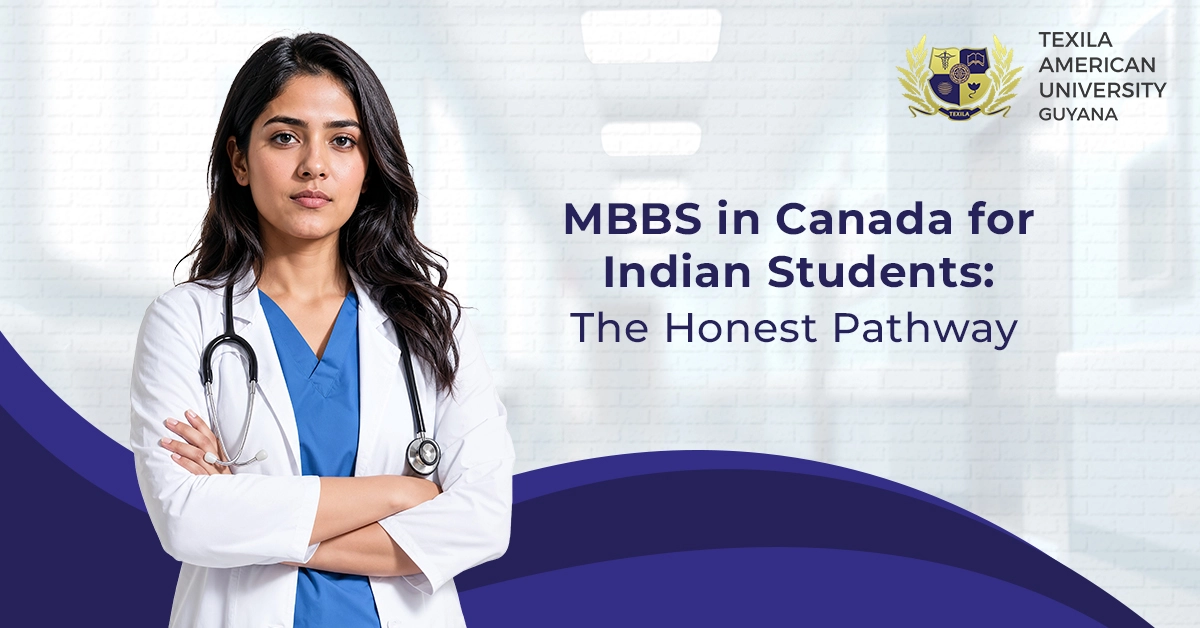
Canada generally awards the MD rather than the MBBS, and admission opportunities for international students are limited and school-specific. Indian students who cannot enter a Canadian medical school directly may consider an eligible medical degree abroad and later pursue the requirements that apply to international medical graduates in Canada. Students who also want to keep India open should verify current NMC Foreign Medical Graduate Licentiate Regulations, FMGE requirements, clinical training, internship, and registration rules before choosing a foreign medical program.
- Can Indian Students Study MBBS in Canada?
- Why Do Indian Families Consider Canada?
- Can Indian Students Study Medicine in Canada After Class 12?
- What Is the Alternative Route to Canada?
- How Does a Caribbean MD to Canada Pathway Work?
- What About the U.S. Route?
- Can Indian Students Keep India Open?
- How Does TAU Fit for Indian Students?
- What About Canadian Immigration?
- How Much Does the Route Cost for Indian Families?
- Five Questions Indian Families Should Ask
- Frequently Asked Questions
- Choose the Pathway With the End Goal in Mind
Can Indian Students Study MBBS in Canada?
Yes, Indian students can study medicine in Canada if they meet the requirements of a Canadian medical school that accepts their applicant category.
However, Canada generally does not award an MBBS. Canadian medical schools award the Doctor of Medicine (MD).
The admission system is also different from the direct-entry MBBS route familiar to many Indian families. Canadian medical faculties establish their own academic prerequisites, and previous university-level study is commonly required.
Admission requirements may include:
- previous university study;
- prerequisite subjects;
- GPA requirements;
- MCAT or other assessments;
- interviews;
- language requirements; and
- citizenship, residency, or regional criteria.
International places can also be very limited.
For a complete explanation of the Canadian medical education system, read our MBBS in Canada: Complete Guide for International Students.
For an Indian family, the most useful question is therefore not simply:
“Can my child study MBBS in Canada?”
It is:
“Which medical pathway is actually available to the student now, and where could that degree lead after graduation?”
Why Do Indian Families Consider Canada?
Canada is attractive for understandable reasons. Families may value its healthcare system, academic reputation, quality of life, international environment, and potential long-term career opportunities.
Some students also associate studying in Canada with future immigration.
But medical education and immigration are separate processes.
Medical-school admission, study permits, permanent residence, residency matching, and medical licensure are governed by different rules.
Studying medicine in Canada does not automatically guarantee residency, permanent residence, or medical licensure. Likewise, studying medicine outside Canada does not necessarily close the Canadian pathway.
Families should separate three questions:
Where can the student study medicine?
Where can the graduate apply for residency?
Where can the graduate eventually qualify to practice?
Understanding those differences early can prevent expensive assumptions.
Can Indian Students Study Medicine in Canada After Class 12?
For most Indian students completing Class 12, Canada does not follow the same direct-entry model as an Indian MBBS.
A typical Canadian pathway may look like:
Class 12 → university or premedical study → Canadian MD application → MD → residency → provincial licensure
Completing university study in Canada, however, does not guarantee admission to medical school.
International students may face additional restrictions because individual schools can limit admission according to citizenship, permanent-resident status, province, academic background, or applicant category.
If you want to compare individual institutions and international eligibility, see our guide to the best medical colleges in Canada.
For some Indian families, spending several years completing undergraduate education before competing for a limited number of medical-school opportunities may not fit their timeline or budget.
That is when an eligible international medical pathway becomes worth evaluating.
What Is the Alternative Route to Canada?
An Indian student may complete an eligible medical degree outside Canada and later pursue the requirements that apply to international medical graduates (IMGs).
A simplified pathway may look like:
Eligible medical degree abroad → credential/MCC requirements → NAC Examination → CaRMS eligibility → residency → provincial licensure
This should be viewed as a pathway, not a guarantee.
Depending on the Match cycle and province, IMG applicants may need to meet requirements involving:
- medical-school eligibility;
- credential verification;
- required examinations;
- NAC Examination;
- Canadian citizenship or permanent-resident status;
- provincial criteria; and
- individual residency-program requirements.
A foreign medical degree alone does not guarantee entry into the Canadian residency Match.
That makes school selection especially important.
How Does a Caribbean MD to Canada Pathway Work?
For some Indian students, an eligible Caribbean MD program can provide a more direct route into medical education than first completing several years of undergraduate study in Canada.
But the word eligible matters.
Before enrolling, verify:
- accreditation;
- World Directory of Medical Schools listing;
- applicable Canada Sponsor Note;
- degree eligibility;
- clinical training locations;
- examination pathways; and
- postgraduate eligibility.
Texila American University College of Medicine in Guyana offers MD pathways for international students and publishes information about its accreditation, WDOMS listing, Sponsor Notes, clinical training, and postgraduate pathways.
Students should still independently verify current MCC, CaRMS, provincial, immigration, and residency-program requirements.
An eligible medical school can help keep a pathway available.
It cannot guarantee a Canadian residency Match, immigration status, or medical license.
What About the U.S. Route?
Indian students considering international medical education may also keep the United States in their long-term plan.
For the U.S., international medical graduates generally need to meet the relevant ECFMG, USMLE, residency, and state-licensure requirements.
Canada has a separate pathway involving Canadian IMG requirements.
That means the U.S. and Canadian routes should be viewed as parallel options rather than shortcuts into one another.
TAU offers medical education pathways with USMLE-oriented academic preparation and clinical training opportunities in Guyana and the United States for eligible students.
For students who want flexibility across North America, this can be useful—but examination performance, citizenship or immigration status, residency eligibility, finances, and individual career goals will still determine what options are realistically available.
Can Indian Students Keep India Open?
This is one of the most important parts of the decision.
If an Indian or OCI student completes a primary medical qualification outside India and later wants to practice in India, the student and medical program must satisfy the applicable National Medical Commission regulations.
Current requirements for foreign medical graduates can involve:
- Foreign Medical Graduate Licentiate Regulations;
- FMGE or the applicable screening/licensing examination;
- required medical subjects;
- course duration;
- clinical training;
- internship requirements;
- medium of instruction;
- local licensure eligibility; and
- registration requirements in India.
FMGE remains operational in 2026. Students should monitor NMC and NBEMS for future regulatory changes, including any transition involving NExT.
Importantly, students should not rely only on a statement that a foreign university is “NMC approved.”
The better question is:
“Does my complete medical education and clinical-training pathway satisfy the NMC requirements that apply to me?”
This should be verified before enrollment, particularly if returning to India remains part of the student’s plan.
How Does TAU Fit for Indian Students?
TAU Guyana offers different entry pathways according to a student’s previous education.
These include:
4-Year MD: for students who already have substantial undergraduate or premedical education.
5-Year Premed–MD: designed for eligible students entering with qualifications such as India/Nepal 10+2, A-Levels, IB, or CAPE.
5.5-Year Premed–MD: for applicants who require a longer premedical foundation before progressing into the MD curriculum.
For an Indian student researching medical education after Class 12, the 5-Year Premed–MD pathway may therefore be particularly relevant, subject to current admission requirements.
Students should review TAU’s latest admissions, accreditation, clinical training, tuition, and postgraduate-pathway information before making a decision.
What About Canadian Immigration?
Canadian immigration rules should be treated separately from medical-school admission.
Study permit, Provincial or Territorial Attestation Letter, permanent residence, and other immigration requirements can change over time.
More importantly, completing medical education—whether in Canada or elsewhere—does not automatically provide Canadian permanent residence.
IMG applicants also need to satisfy the citizenship or permanent-resident and other eligibility rules that apply to their particular CaRMS Match cycle.
Families should therefore avoid selecting a medical program solely because they assume it will lead automatically to Canadian immigration.
How Much Does the Route Cost for Indian Families?
There is no single figure for MBBS in Canada for Indian students’ fees.
A Canadian route may involve undergraduate education before medical school, followed by MD tuition, living expenses, insurance, examinations, and other costs.
An international MD pathway may include:
- tuition;
- living expenses;
- clinical-training costs;
- examination fees;
- visa and immigration expenses;
- travel;
- insurance; and
- postgraduate application costs.
Indian families also need to consider currency movements when fees are charged in CAD or USD.
Instead of comparing only first-year tuition, calculate:
Tuition + living costs + clinical costs + examinations + travel + postgraduate expenses
For current examples and CAD-to-INR comparisons, read our detailed guide to MBBS in Canada fees.
Five Questions Indian Families Should Ask
Before choosing an international medical program, ask:
- Is the program appropriately accredited?
- Does the degree support the postgraduate pathways I am considering?
- Where will clinical training and internship take place?
- What examinations and residency requirements apply after graduation?
- What is the complete cost through graduation?
Indian students should add one more:
Will my medical education and clinical-training pathway meet applicable NMC requirements if I later want to practice in India?
Frequently Asked Questions
Choose the Pathway With the End Goal in Mind
For an Indian family, Canada can remain part of a long-term medical-career plan.
But choosing a medical school should not begin with a country name alone.
Ask:
What qualification does the student have today?
Where do they want to practice after graduation?
Do they want to keep India open?
Are Canada, the United States, or both part of the plan?
What budget and level of admission risk are realistic?
For some students, applying to a Canadian MD program may make sense.
For others, an eligible international MD pathway may provide a more direct route into medical education while keeping multiple postgraduate options under consideration.
The important step is understanding the academic, regulatory, financial, and postgraduate pathway before committing years of study and family investment.