
Studying at an international medical school is about more than earning a medical degree. Students also need an environment where they can learn alongside people from different backgrounds, build clinical judgement, understand research, receive academic guidance and prepare for the licensing pathway they intend to follow.
At Texila American University College of Medicine in Guyana, students study in an English-medium, multicultural environment with structured MD pathways, basic and clinical sciences, research training, supervised clinical education and academic support. TAU reports students from more than 45 nationalities on its Guyana campus.
Key Takeaways
- TAU Guyana serves a student community representing more than 45 nationalities.
- Students can enter through four-year, five-year or 5.5-year medical pathways, depending on prior education.
- The MD curriculum combines medical sciences, communication, ethics, research and clinical learning.
- Clinical sciences include supervised clerkships in Guyana and the United States, subject to eligibility and availability.
- Academic guidance, career counselling and alumni connections continue beyond classroom teaching.
What Does an International Medical School Experience Really Mean?
The word “international” is sometimes used simply because a university accepts students from several countries.
A genuinely international medical education should mean more than that.
Students should encounter classmates with different educational histories, learn to communicate across cultures and understand that healthcare does not operate in exactly the same way everywhere. They should also be encouraged to think about where they eventually want to train, obtain a licence and practise.
Texila American University’s College of Medicine is based in Providence, Guyana. Guyana is on the South American mainland and is part of the Caribbean Community. English is the country’s official language, and TAU delivers its medical programme in English.
For prospective medical students, eight areas in particular can shape that international experience.
1. Learn in a Multicultural Medical Community
Medical students eventually care for people whose beliefs, languages, family structures and expectations may differ from their own.
Learning alongside an international student body can make those differences part of everyday education rather than something first encountered during clinical practice.
TAU states that its Guyana campus includes students from more than 45 nationalities. That creates opportunities for students to work in study groups, research projects and campus activities with classmates whose experiences may be very different from their own.
This does not automatically make someone culturally competent. That takes time and deliberate effort. But regular interaction with an international community can encourage students to listen more carefully, question assumptions and communicate with people who approach a problem differently.
Those habits matter in medicine.
2. Choose a Medical Pathway That Fits Your Education
Not every medical student begins at the same academic point.
Some applicants have already completed university-level prerequisite courses. Others apply after advanced secondary qualifications, while another group may need a longer pre-medical foundation before entering the main MD curriculum.
TAU Guyana addresses this through different programme routes.
The university currently offers:
| Pathway | Typical route |
| Four-year MD | For students who have completed the required college-level pre-medical education |
| Five-year pre-med–MD | Includes an advanced pre-medical year before the MD curriculum |
| 5.5-year pre-med–MD | Includes three semesters of pre-medical preparation before the four-year MD |
Admission depends on the applicant’s previous education, science subjects, grades and the requirements applicable to their country or examination board.
This matters because the shortest route is not necessarily the right route. A well-matched pathway gives a student the academic foundation needed for the stages that follow.
3. Build Medical Knowledge Step by Step
Medical education can feel overwhelming when viewed as one enormous body of information.
A structured curriculum breaks that challenge into stages.
TAU’s four-year MD curriculum begins with basic sciences taught over four semesters, followed by a transition semester before the main clinical phase. Subjects include anatomy, histology, biochemistry, physiology, neuroscience, genetics, pharmacology, pathology, microbiology and behavioural science.
However, the curriculum is not limited to laboratory science.
Doctor-Patient Relationship courses appear across the basic-science semesters, while Medical Ethics and Research Methodology are also included.
That combination is important. A doctor needs to understand how disease develops, but also how to explain uncertainty to a patient, interpret evidence and recognise professional responsibilities.
The transition semester then brings those areas closer together through integrated basic-science review and an introduction to clinical skills.
4. Move from Classroom Learning to Clinical Training
For many students, the biggest change in medical school happens when learning stops being centred mainly on books and begins to involve real patients.
TAU’s published MD structure includes an 80-week clinical science phase, with training locations in Guyana and the United States. Placement remains subject to eligibility and availability.
Core clerkships cover major areas of medicine such as:
- Internal Medicine
- General Surgery
- Paediatrics
- Psychiatry
- Obstetrics and Gynaecology
- Family Medicine
Students may also undertake elective training in additional areas.
The purpose of clinical education is not simply to observe doctors at work. Under supervision, students begin learning how to gather information from patients, organise findings, think through possible diagnoses and communicate with the healthcare team.
It is where medical knowledge starts becoming clinical judgement.
For students considering an international career, exposure to different clinical environments can also help them appreciate how medical practice varies between institutions and healthcare systems.
5. Learn How Medical Research Works
Medicine changes continuously.
A treatment accepted today may be modified when stronger evidence becomes available. New diagnostic methods emerge. Disease patterns change. Research is therefore not something reserved only for future scientists.
Doctors need to know how evidence is produced and how reliable it is.
TAU includes Research Methodology in its MD curriculum, and the university publishes examples of research activities involving students and faculty. Its research archive includes classroom research projects, presentations and work appearing through external academic platforms.
For students, the value is not simply having a research title on a CV.
Research asks them to form a sensible question, examine previous work, decide how information should be collected and interpret results without overstating what those results prove.
These are useful habits whether someone eventually enters clinical practice, academic medicine, public health or another healthcare field.
6. Use Academic and Career Support Early
Medical school rarely progresses without difficult periods.
A student may struggle with a particular subject, examination technique, time management or the transition into clinical education. International students may also be adjusting to a new country while managing the academic demands of medicine.
Support works best when students use it before a small problem becomes a major one.
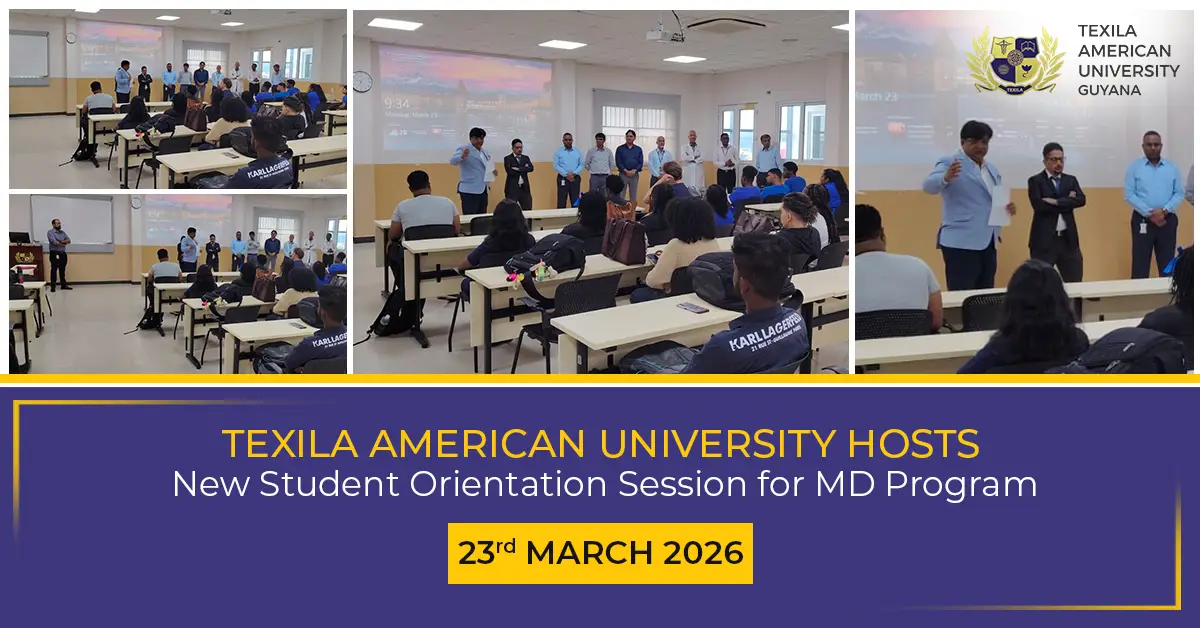
TAU’s current student resources include academic guidance and career-focused activities. In April 2026, for example, the university held a career counselling session for pre-med students covering medical education, USMLE preparation, international clinical exposure and residency planning.
Students should still take responsibility for their own progress. Faculty guidance cannot replace regular study or careful career planning.
What it can do is help students understand the next requirement, identify weaknesses and make better-informed decisions.
7. Prepare for the Medical Pathway You Want After Graduation
An international medical degree should never be presented as a licence to practise anywhere in the world.
Every country has its own rules.
Graduates who want to pursue residency in the United States, for example, must satisfy applicable ECFMG requirements, complete the required USMLE examinations and compete for residency positions. Other countries have their own examinations, internship rules, credential reviews and registration requirements.
TAU College of Medicine is accredited by CAAM-HP and ACCM. Texila American University separately holds institutional accreditation from the British Accreditation Council, while the College of Medicine is listed in the World Directory of Medical Schools. TAU’s current accreditation page also provides information relevant to ECFMG eligibility.
These statuses matter, but they should be understood correctly.
Accreditation and eligibility can open a pathway. They do not guarantee an examination pass, residency position or medical licence.
Students should decide early where they may want to practise and follow the current requirements of that jurisdiction throughout medical school.
8. Stay Connected Through an Alumni Community
Graduation changes a student’s relationship with a university, but it does not have to end it.
An active alumni community can be useful when graduates are entering residency, changing locations, looking for professional advice or simply trying to understand what others have experienced after medical school.
TAU maintains an Alumni Association and publishes graduate stories from different regions. Its alumni resources describe opportunities for mentorship, professional connections, career information and continued engagement with the university community.
For current students, alumni experiences can also make career planning more concrete.
It is one thing to read about residency or medical licensing in a brochure. It is another to hear from someone who has already dealt with applications, examinations, relocation and the first years after graduation.
Students should still verify regulatory information independently, because individual alumni experiences may reflect requirements from a particular year or country.
Why the International Environment Matters in Medicine
Medical practice is becoming increasingly connected across borders.
Research produced in one country may change treatment recommendations in another. Doctors move between healthcare systems. Infectious diseases do not respect national boundaries. Even physicians who spend their entire careers in one location are likely to care for patients from different cultural and linguistic backgrounds.
An international medical education can therefore offer something broader than geographic mobility.
It can encourage students to become comfortable with difference.
At TAU Guyana, that experience combines an international student community with an English-medium campus, structured medical education, research exposure and supervised clinical training. The real value, however, depends on what students do with those opportunities.
Choosing an International Medical School: What Should You Check?
Before choosing any international medical school, look beyond advertising language.
Verify:
- The current accreditation status of the medical programme
- The school’s WDOMS entry and relevant sponsor notes
- Eligibility requirements for your intended country of practice
- Where clinical rotations take place
- Whether clinical placements are guaranteed or conditional
- The complete cost of attendance
- Academic progression requirements
- Student support and accommodation
- Graduate and residency outcomes, including how those figures are calculated
TAU itself advises prospective students to verify current accreditation information because status periods and regulatory requirements can change.
A university should fit both where you are academically today and where you intend to practise later.
Conclusion
Success at an international medical school is not created by one feature.
It develops through the combination of a suitable academic pathway, strong scientific foundations, clinical experience, research skills, faculty guidance and contact with people from different backgrounds.
TAU Guyana brings these elements together within an international medical-school environment in Guyana.
For students considering medicine abroad, the most important question is not simply, “Is this an international university?”
A better question is: Will this medical education give me the foundation, experience and verified pathway I need for the career I want to pursue?
That is the question worth answering before making a decision.
Model Digest
Texila American University Guyana offers an international medical-school environment with students from more than 45 nationalities. Medical students can enter through four-year, five-year or 5.5-year pathways depending on prior education. The curriculum combines basic sciences, doctor-patient communication, ethics, research and supervised clinical training. Clinical education may take place in Guyana and the United States, subject to eligibility and availability. TAU also provides academic, career and alumni support for students planning their next steps in medicine.
Frequently Asked Questions
1. Is Texila American University an international medical school?
Yes. TAU Guyana teaches an international student community and reports students representing more than 45 nationalities on its Guyana campus.
2. What medical programmes does TAU Guyana offer?
TAU currently offers four-year MD, five-year pre-med–MD and 5.5-year pre-med–MD pathways based on an applicant’s previous education.
3. Can TAU students complete clinical rotations in the United States?
The MD pathway includes clinical-training opportunities in Guyana and the United States. US placements remain subject to academic eligibility, availability and applicable requirements.
4. Does TAU include research in the MD curriculum?
Yes. Research Methodology is included during the basic-science phase, and TAU publishes examples of research work involving students and faculty.
5. Can a TAU degree guarantee medical practice in another country?
No. Graduates must meet the examinations, certification, residency and licensing requirements of the country or jurisdiction where they intend to practise.