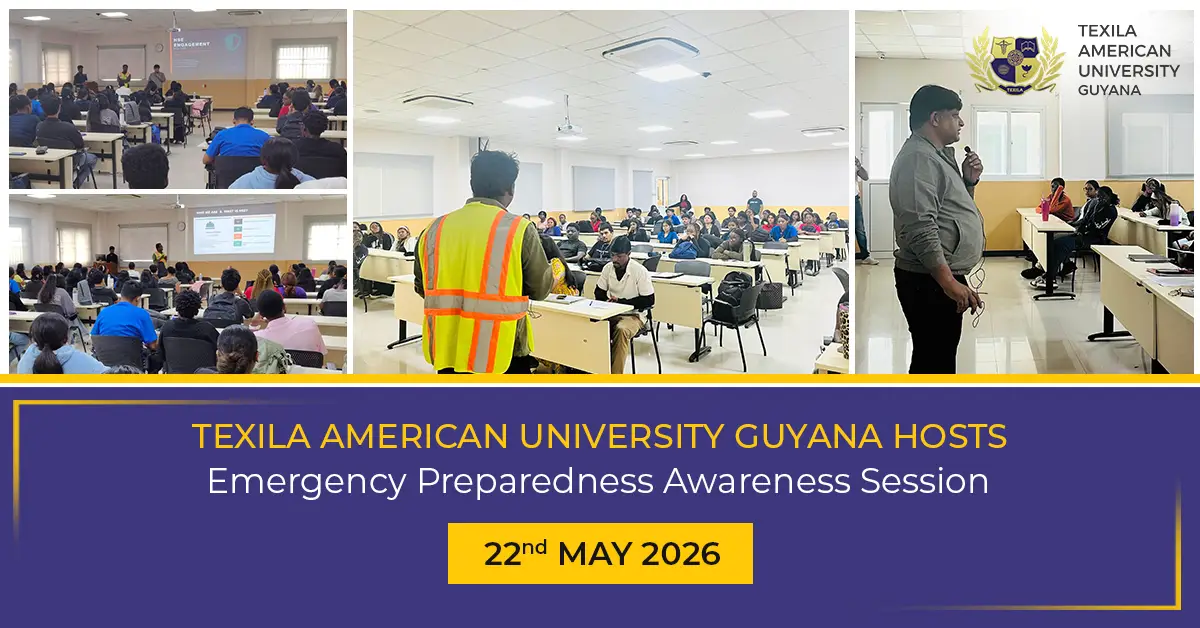
Georgetown, Guyana — 22 May 2026: Texila American University, Guyana campus, hosted an Emergency Preparedness Awareness Session to strengthen safety awareness, environmental responsibility, and emergency readiness among students, faculty, staff, and campus stakeholders.
The session formed part of the university’s continued commitment to creating a safe, healthy, and responsible learning environment. It focused on Health, Safety and Environment principles, ISO-based safety standards, emergency response planning, fire safety awareness, and the shared responsibility of every member of the campus community.
Building a Stronger Culture of Safety on Campus
The session was introduced by Dr. Dheeraj Bansal, CAO & Dean, who highlighted the importance of proactive safety practices within an academic and healthcare-focused learning environment.
The session was further presented by Mr. Emmanuel Samuel, Senior HSEQ Advisor, an experienced Health, Safety, Environment and Quality professional. Mr. Samuel is an ISO Certified Internal Auditor for IMS 9001, 14001, and 45001, accredited by DNV-GL, and a Certified Risk Assessment and Incident Investigation Professional.
Through practical examples and structured guidance, the session encouraged participants to understand that emergency preparedness is not only a compliance requirement but also a daily responsibility.
Key Areas Covered During the Session
The Emergency Preparedness Awareness Session covered four important areas connected to internationally recognised health, safety, and environmental management practices.
Introduction to HSE and ISO Standards
Participants were introduced to the foundational principles of Health, Safety and Environment and the role of the International Organization for Standardization in creating structured frameworks for quality, safety, and environmental management.
The discussion helped participants understand how HSE practices contribute to safer workplaces, responsible campus operations, and stronger institutional preparedness.
ISO 45001 and Occupational Health and Safety
A major part of the session focused on ISO 45001:2018, the international standard for occupational health and safety management systems.
Participants learned how ISO 45001 supports organisations in identifying hazards, managing workplace risks, improving safety performance, and protecting the well-being of employees, students, visitors, and other stakeholders.
For a university environment, this awareness is especially important because campus safety depends on early risk identification, clear procedures, and active participation from everyone.
ISO 14001 and Environmental Management
The session also introduced participants to ISO 14001:2015, the international standard for environmental management systems.
This section explained how institutions can manage environmental responsibilities in a systematic and sustainable way. Topics included environmental awareness, responsible resource use, risk control, and the importance of reducing the environmental impact of daily operations.
By connecting emergency preparedness with environmental responsibility, the session reinforced Texila American University’s broader commitment to responsible and sustainable campus management.
Emergency Preparedness and Fire Safety
A significant portion of the session was dedicated to emergency preparedness and fire safety. Participants were guided through common campus-related hazards such as fire, electrical risks, chemical spills, and structural threats.
The session also explained step-by-step emergency response protocols, including how to respond during an emergency, how to follow evacuation procedures, and how to support coordinated action through the Emergency Response Team.
Participants were familiarised with the emergency equipment available across the TAU Guyana campus, including:
- Fire extinguishers
- Smoke detectors
- First aid kits
- Emergency exit signage
- Floor-wise evacuation plans
- Campus emergency response arrangements
The presence of evacuation plans on every floor of each block was highlighted as an important part of campus safety readiness. These plans help students, staff, and visitors identify safe exit routes and respond quickly during emergencies.
Encouraging Responsibility Through Open Discussion
The session concluded with an open question-and-answer discussion. Participants were encouraged to clarify doubts, share observations, and take greater ownership of safety practices in their daily environment.
This interactive approach helped reinforce the idea that safety is most effective when everyone is informed, alert, and prepared to act responsibly.
Texila American University’s Commitment to Campus Safety
Texila American University, Guyana remains committed to maintaining a safe, healthy, and environmentally responsible campus for all students, staff, faculty, and visitors.
By hosting awareness sessions such as this, the university continues to promote a culture of preparedness, prevention, and shared responsibility. The Emergency Preparedness Awareness Session reflects Texila American University Guyana’s ongoing efforts to strengthen institutional safety standards and prepare its campus community to respond effectively to emergency situations.
FAQ:
What was the purpose of the Emergency Preparedness Awareness Session at TAU Guyana?
The session aimed to strengthen awareness of campus safety, emergency response, fire safety, environmental responsibility, and internationally recognised HSE standards among the university community.
Who conducted the session at Texila American University Guyana?
The session was introduced by Dr. Dheeraj Bansal, CAO & Dean, and presented by Mr. Emmanuel Samuel, Senior HSEQ Advisor and certified HSE professional.
What topics were covered during the session?
The session covered HSE principles, ISO standards, ISO 45001 occupational health and safety, ISO 14001 environmental management, emergency response protocols, and fire safety awareness.
Why is emergency preparedness important on a university campus?
Emergency preparedness helps students, staff, and visitors respond quickly and safely during incidents such as fire, electrical hazards, chemical spills, or evacuation situations.
What emergency equipment is available across the TAU Guyana campus?
The campus includes fire extinguishers, smoke detectors, first aid kits, emergency exit signage, and evacuation plans installed across blocks and floors.