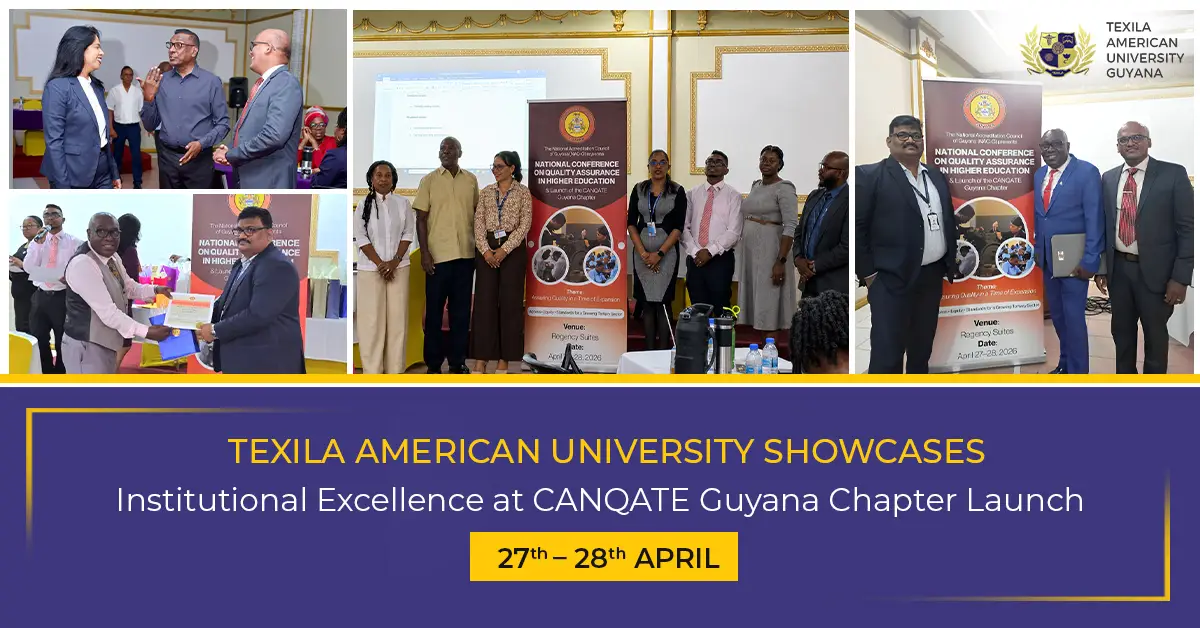
Texila American University (TAU) was represented by Mr. Saravanan K R, Academic Head – Non-Medicine Programs, and Dr. Rakesh Kumar ER, Dean – IQAC & Controller of Examinations, at the two-day Workshop and Launch of the Guyana Chapter of the Caribbean Area Network for Quality Assurance in Tertiary Education (CANQATE), hosted by the National Accreditation Council of Guyana at Regency Suites on April 27–28, 2026.
The conference brought together key stakeholders from academia, regulatory bodies, and industry to deliberate on policy, leadership, systems, standards, and shared responsibility in higher education quality assurance.
National Leadership & Strategic Direction
The event was officially launched by the Honourable Minister of Education, Ms. Sonia Parag, who emphasised the Government’s commitment to ensuring that expanded access to education is matched with strong quality assurance systems.
She further highlighted that quality assurance plays a vital role in protecting students, strengthening institutions, and building a globally competitive workforce. The conference featured keynote addresses, expert talks, and panel discussions addressing key themes such as quality in a time of expansion, graduate readiness and workforce needs, quality assurance in online, hybrid and alternative credentials, and access, equity, and standards in national expansion.
Institutional Case Study Presentation – Texila
A key highlight of the conference was the Institutional Case Presentation session (Day 2), where Mr. Saravanan K R was selected to represent Texila American University among three institutions.
He presented:
“Quality by Design: Texila’s Systems-Driven Approach to Scaling Without Compromise”
The presentation focused on a structured and systems-driven approach to quality, including a robust academic governance framework, KPI-based monitoring using a Balanced Scorecard approach, institutional investment in a technology-enabled academic ecosystem, student performance tracking with early intervention mechanisms, and standardised policy enforcement.
The case study demonstrated that at Texila-GY, quality is not dependent on individuals but is embedded within institutional systems and processes, ensuring consistency, scalability, and sustained academic excellence.
Conclusion
Texila American University’s participation in this national initiative reinforces its commitment to advancing quality assurance through structured systems, continuous evaluation, and technology-driven academic delivery, contributing to a globally aligned higher education ecosystem in Guyana.
At Texila American University, expansion is inevitable—but quality must always be intentional.